The right agency isn’t simply the one with the lowest quote. It’s the one whose scope, process, and deliverables fit your budget and business goals. Knowing how to choose a web development agency means reviewing the contract and asset ownership, examining relevant work, and clarifying who handles each responsibility. Clear terms and a reliable process matter as much as technical capability.
It’s reasonable to start with budget, but a low initial cost can hide gaps in scope, communication, or post-launch support. Compare more than proposals: understand how each team plans, builds, tests, and supports the website, and what your own team must provide along the way.
This guide explains what to learn before choosing a web development company, including how to assess its services and references. Use the practical framework to compare contracts, design portfolios, development processes, and client responsibilities, then align the project with your budget.
Key Takeaways
- Define your project goals and clarify ownership, scope, and deliverables in the contract before work begins.
- Review relevant portfolio projects on mobile and desktop to assess usability, design judgment, and technical fit.
- Map the agency’s development stages against your team’s responsibilities, from supplying content to reviewing work.
- Compare service fit and client references to judge how well an agency communicates, handles project needs, and supports the work.
1. Contract terms and ownership of website assets
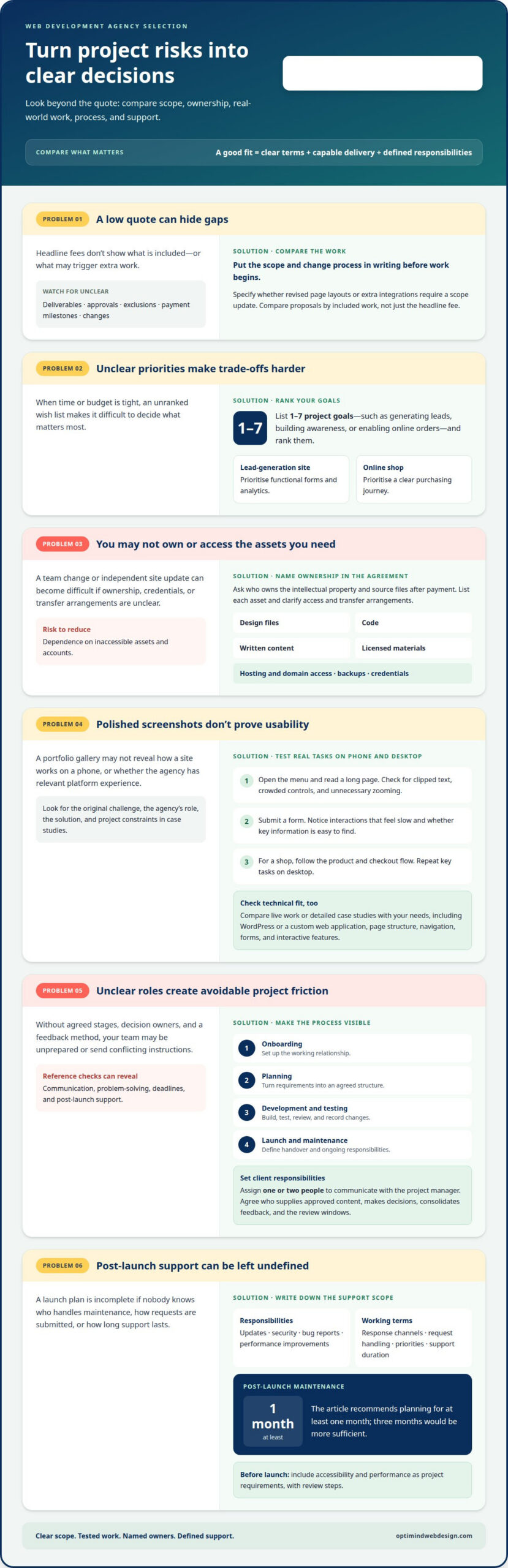
Start with the contract, not the mock-up. Define deliverables, approval stages, payment milestones, exclusions, and the change-request process. For example, specify whether revised page layouts or extra integrations require a scope update. A clear breakdown helps you compare proposals by the work included, not just the headline fee.
Set priorities before briefing a web development company. List 1-7 goals, such as generating leads, building awareness, or enabling online orders, then rank them. That ranking guides decisions when time or budget requires trade-offs. A lead-generation site, for example, needs functional forms and analytics; an online shop needs a clear purchasing journey.
Ask who owns the website’s intellectual property and source files after payment. List the assets in the agreement, including design files, code, written content, and licensed materials. Clarify account access and transfer arrangements, too. These terms matter if you later change teams or need to update the site independently.
Template-based websites use pre-designed HTML pages filled with text and images. They can suit straightforward projects with standard layouts. Custom development involves audience research, tailored design, and features built around specific needs. E-commerce sites can use an existing platform or a custom build. Choose based on required functionality and likely future changes, not appearance alone.
An agency brings a coordinated team, while a freelancer typically works independently and an in-house developer works within your organisation. The best fit depends on project scope, required expertise, and how much ongoing work your team can manage.
Agency risks include unclear scope, unmet expectations, and dependence on inaccessible assets. Reduce them with written deliverables, named approval owners, documented change control, and explicit ownership terms. Agree how to resolve delays and record decisions, so each project stage has a clear next step and an accountable owner.
Confirm maintenance scope, response channels, security responsibilities, update handling, and post-launch support duration in the contract. Clarify who can access hosting and domain accounts, and who owns backups and credentials. Include accessibility and performance as project requirements, with review steps before launch.
2. Custom design portfolio and mobile usability
Treat a portfolio as evidence of decisions, not just a gallery of polished screens. Select similar projects, then open their live websites on a phone and computer. Look at how the design communicates the organisation’s purpose, guides visitors, and supports key tasks. For a service business, check how quickly users can find contact details and understand the offer.
Case studies provide context that screenshots can’t. Look for the original challenge, the agency’s role, and the solution delivered. For example, a case study might explain how a complex service menu became clearer to navigate. Check whether it describes the team’s contribution and project constraints, rather than attributing every result to design alone.
Test mobile usability by completing real tasks. On a phone, open the menu, read a long page, submit a form, and follow an online shop’s product and checkout flow. Look for clipped text, crowded buttons, interactions that feel slow, and layouts that require unnecessary zooming. Repeat the tasks on desktop. Responsive design should preserve function and clarity across screen sizes, not merely shrink the desktop layout.
Assess technical fit as well as visual style. If your project needs WordPress or a custom web application, look for relevant platform experience in live work or detailed case studies. Review page structure, navigation, forms, and interactive features. Compare them with your priorities, noting where the agency’s examples are a close match and where they aren’t.
Research the agency’s wider digital presence by reviewing its website, social profiles, and published content. Consistent, useful explanations can reveal how the team communicates its approach. Before launch, define the design review process and who approves changes. If you need a coordinated design and build, explore Web Design and Development as one way to align interface decisions with implementation.
3. Proven development process and client responsibilities
A web development company should explain its process in clear stages: onboarding, planning, development and testing, then launch and maintenance. Ask what each stage produces, who approves it, and how changes are recorded. Planning, for example, should turn your requirements into an agreed structure before development begins. Defined checkpoints make progress visible and help your team prepare.
Use client recommendations, reviews, and testimonials to assess delivery and the working relationship. Read beyond star ratings: look for specific comments about communication, problem-solving, deadlines, and post-launch support. Case studies show how a team approached a challenge, while references provide direct context. Ask previous clients what went smoothly, what needed extra coordination, and how the agency handled issues.
Clarify your role before kickoff. Assign one or two people to communicate directly with the agency’s project manager. They can consolidate feedback, supply approved content, and make decisions without conflicting instructions. Agree on review windows and the format for feedback. For example, one consolidated response on a page design is more actionable than competing notes from several departments.
Maintenance needs an owner and a defined scope. Confirm who handles updates, security tasks, bug reports, and performance improvements after release, plus how requests are submitted and prioritised. Plan at least one month of post-launch maintenance; three months would be more sufficient. If your team lacks time for routine site work, include ongoing support in the project discussion rather than leaving responsibilities unresolved.
Compare references with your needs. A business launching an online shop should seek feedback from a client with similar e-commerce requirements; a lead-generation project benefits from references familiar with forms and analytics. Ask how the agency planned, tested, and supported the work. Specific answers about handoffs and problem-solving provide stronger evidence than general praise.
4. Questions about agency services and references
Compare proposals by matching deliverables, exclusions, milestones, and approval points, not by comparing totals alone. Pricing depends on project scope, features, and agency expertise, and is provided after a quote request. Check that each timeline connects work stages with decisions, content handoffs, testing, and launch, so you can see what drives the schedule.
Ask who will lead the project, which specialists will do the technical work, and how the team will communicate progress. Request an explanation of likely risks, dependencies, and decisions your team must make. A clear answer connects the proposed approach to your goals instead of relying on broad claims about quality or speed.
Confirm that the agency’s services match the build. A WordPress site, e-commerce platform, and custom web application require different capabilities. Ask which platforms the team works with, how it chooses an approach, and which integrations and functions the proposal covers. This shows whether the scope fits your requirements or leaves key work unresolved.
Ask how the agency will measure progress and evaluate the finished site. For a lead-generation website, discuss form functionality and analytics; for an online shop, cover usability and performance. Ask how accessibility and performance are addressed in planning and testing. Specific criteria make the intended quality easier to assess than a vague promise of a modern website.
Clarify who will handle updates, security tasks, and improvements after launch, and which items the agreement covers. Request references from clients with comparable needs, then ask about communication, decision-making, delivery, and support. Their examples can show how the agency responds when requirements change or technical issues arise.
Use the answers to compare fit, not just presentation. If your project needs a tailored website or digital platform, discuss your web development project with a team that can align design and technical execution.
Optimind Technology Solutions: Web Design and Development
Optimind Technology Solutions helps businesses turn website requirements into purposeful digital experiences through Web Design and Development, UX Design, and tailored technical builds. Its services support projects that need a custom web application or e-commerce platform, from interface planning through development. It’s a good fit when design, functionality, and business priorities need to work as one system.
Bring your goals, preferred platforms, essential features, and client responsibilities into the first discussion. This gives the team a clear basis for shaping the project scope and approach. Businesses refining an existing site can also explore a focused redesign aligned with their users’ needs.
To discuss your website project, visit optimindwebdesign.com.
Turn your agency decision into a clear project direction
Turn your priorities into a focused project brief. Define the business outcome, essential functionality, and constraints your team must work within. This gives every discussion a practical starting point and keeps decisions tied to the website’s purpose.
Knowing how to choose a web development agency matters beyond the selection itself. The right working relationship connects design decisions with technical requirements and your organisation’s capacity to manage the result. Optimind Technology Solutions offers Web Design and Development, Custom Web Application Development, and UX Design to help businesses shape those needs into a digital project.
Bring your goals and preferred direction into a conversation about the website you want to build or improve. Contact Optimind Technology Solutions to discuss your project and take the next step with a clear direction.
Frequently Asked Questions
What Should You Learn Before Choosing a Web Design Company?
Before choosing, define the business outcome, intended audience, and essential website functions. A distributor, for example, may need product enquiries, while a retailer needs a usable product catalogue. Knowing how to choose a web development agency also means identifying who will provide content, approve decisions, and track results internally. These details help shape a brief agencies can answer with specific, comparable proposals.
What services should a web development agency provide?
Choose services to match your project, not an assumed standard package. A website may need UX design, front-end and back-end development, CMS setup, or e-commerce functionality. A custom internal workflow may call for web application development. Map each requirement to a clear service and deliverable, then identify responsibilities that stay with your team, such as writing product descriptions or managing business information.
How do you evaluate a web development agency’s portfolio and experience?
Look for relevant work and verify what the agency actually contributed. A polished homepage alone doesn’t show whether the team built the underlying features or handled the full project. Ask how a featured example relates to your requirements, which technologies it uses, and whether the people proposing your project will do the work. This helps distinguish visual similarity from applicable technical experience.
What contract terms, milestones, and payment schedules should a web development agreement include?
Define acceptance criteria for each deliverable, such as approved page designs, tested forms, or functioning checkout steps. Tie payment milestones to those documented stages, and state how change requests affect scope, schedule, and invoices. The agreement should also identify third-party expenses, approval responsibilities, and how to resolve delayed inputs. Clear triggers give both sides a shared basis for tracking completion.
How do you check a Philippine web development agency’s references, reviews, and credentials?
Ask for references from organisations with comparable project needs, then speak with those clients about delivery, communication, and post-launch follow-through. Read reviews for specific examples instead of relying only on ratings. Check that the people named in case studies match the team discussing your work, and ask what credentials support technical claims in the proposal. Evaluate each credential against the work required.