
A corporate website is more than a digital brochure: it is where people learn what your business does, whom it serves, and what to do next. Corporate web design standards for enterprise credibility bring that purpose to life through clear information, consistent branding, intuitive navigation, accessible content, and reliable performance.
You already know that polished visuals matter, but credibility also depends on whether visitors can find relevant details, understand your services, and reach your team without friction. This article explains what defines a corporate website, which core pages support its purpose, and how four practical design standards help you build trust across the Philippine market, including accessibility benchmarks from the World Wide Web Consortium.
Key Takeaways
- Build web accessibility into design decisions, including readable contrast, keyboard navigation, and clear labels.
- Align your website’s brand identity and content with your enterprise goals and the audiences you serve.
- Prioritize pages that explain your business, services, expertise, and next steps for visitors.
- Define the website’s scope around business needs, user journeys, and the functions your teams require.
1. What Is Business Website Design?
Business website design connects a company’s goals with the structure, navigation, content, and interactions visitors use. On a corporate website, each page should make information easy to find and actions easy to complete. Accessible design supports this by accommodating people who use keyboards, screen readers, or other assistive technology.
Enterprise and small-business websites share the same foundations: clear navigation, responsive layouts, readable content, and accessible controls. Enterprise sites often apply these principles across more audiences, departments, and page types, while a small-business site may have a narrower scope. In both cases, consistent design makes every page easier to use.
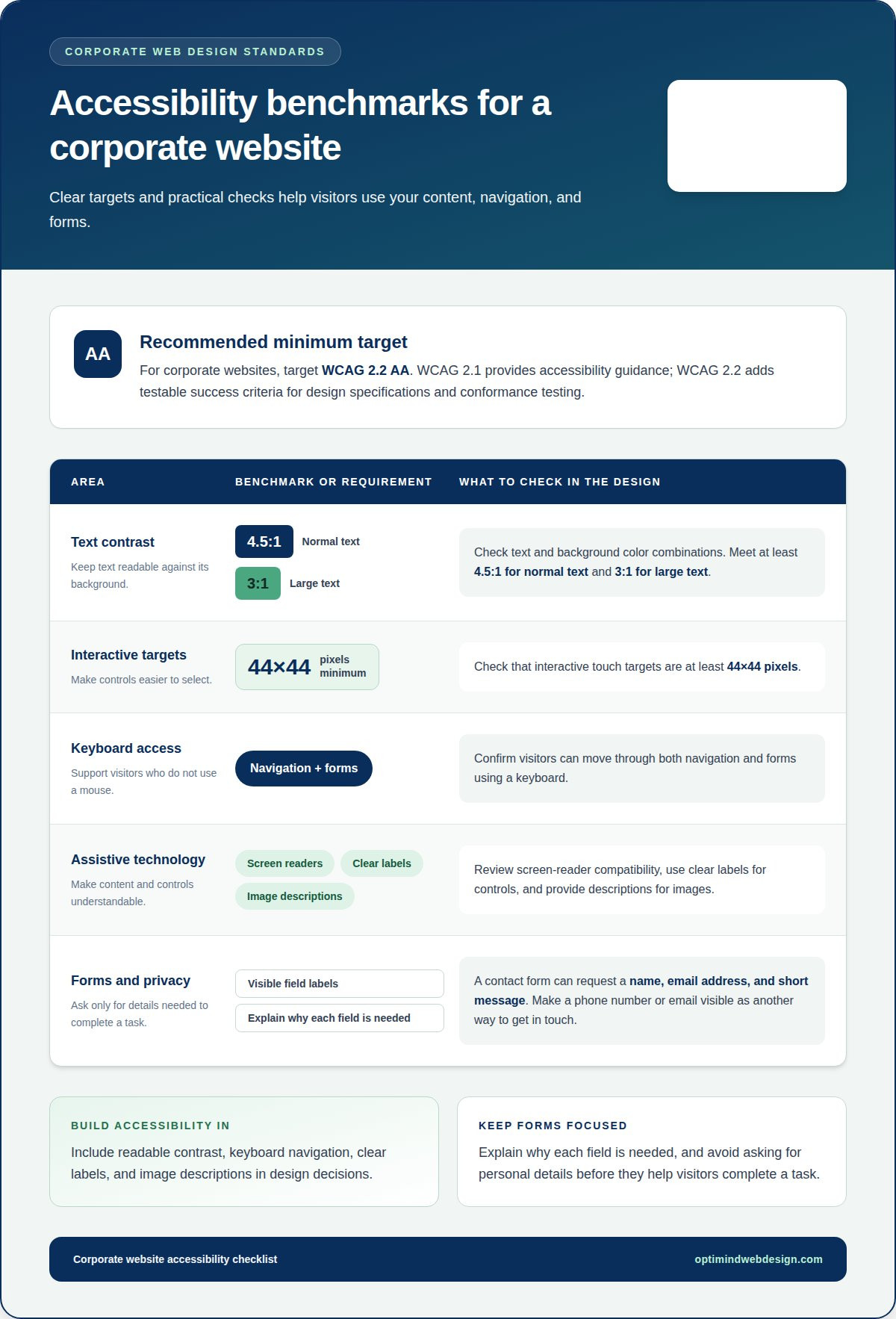
WCAG 2.1 provides accessibility guidance, while WCAG 2.2 offers testable success criteria for design specifications and conformance testing, according to the World Wide Web Consortium. A practical design review can check keyboard access, screen-reader compatibility, clear labels, and image descriptions. These details help visitors understand controls and content without relying on sight or a mouse.
For corporate websites, WCAG 2.2 AA is a recommended minimum target. Use a contrast ratio of at least 4.5:1 for normal text and 3:1 for large text. Make interactive touch targets at least 44×44 pixels, and ensure visitors can move through navigation and forms with a keyboard.
Accessibility and privacy considerations also shape forms. Keep labels visible, explain why each field is needed, and avoid requesting personal details before they help visitors complete a task. For example, a contact form can ask for a name, email address, and short message, while a clearly displayed phone number or email offers another way to get in touch. This keeps business information accessible without forcing visitors through a lengthy form.
2. What Is a Corporate Website?
A corporate website is a company’s central digital presence, built to explain its business, serve its audiences, and support defined goals. Set those goals first: a manufacturer, for example, may prioritize product information, distributor enquiries, and investor updates. The strategy should guide the site’s structure, content, and conversion paths, rather than leaving departments to create disconnected pages.
Brand identity turns that strategy into a recognizable visual system. Set shared rules for colors, typography, logo placement, imagery, and page layouts so every department communicates a consistent identity. Use visual hierarchy to guide attention: lead with a clear headline, follow with supporting details, and place the relevant action where visitors can find it. A product page, careers page, and case study can serve different needs while still creating a coherent impression.
Enterprise branding standards must work across devices and teams. Reusable page templates help preserve heading styles, spacing, and calls to action as content grows. For example, an office can publish service details without changing the corporate logo or navigation. Use customer feedback to refine content and analytics to see which pages support business goals.
For performance, target Largest Contentful Paint below 2.5 seconds, Interaction to Next Paint below 200 milliseconds, and Cumulative Layout Shift below 0.1. These Core Web Vitals targets keep the main content fast to appear, interactions responsive, and the layout steady. A page-load target under 2 seconds is also recommended.
SEO and technical standards start with semantic page structure, descriptive titles, and links that explain their destination. Use programming standards agreed on by the World Wide Web Consortium so pages are more likely to display and behave properly across browsers. Organization, Services, and Breadcrumbs schema can clarify company information and page relationships for search engines. A focused enterprise web design strategy can connect these technical choices with brand consistency and business priorities.
3. Essential corporate website pages
Start with pages that answer visitor needs and support a clear business goal. A homepage should explain what the company does and guide visitors to a relevant action. An About page can present company and leadership information; service pages should describe each offer in plain language. Case studies can outline the challenge, approach, and outcome, while a Contact page makes the next step easy to find.
Choose calls to action to match each page’s purpose. A service page might invite visitors to request information, while a careers page directs candidates to open roles. Give each page one primary conversion goal so its layout and content lead toward a clear action. A prominent call to action helps visitors know what to do next without competing messages.
Business relationship types shape UX. A B2B corporate website may need detailed service information, case studies, and clear paths for procurement or partnership enquiries. A B2C site may prioritize product discovery, support, or purchase actions. Map the audiences and their tasks first; then arrange navigation and page elements around those needs. The site must serve each audience without burying essential information.
Present company information on specific, current pages. Give leadership a clear place in the About section, describe services on dedicated pages, and make contact details easy to find in the header or footer. An email address, phone number, and contact form provide practical ways to reach the business. Share useful information directly instead of placing it behind a lengthy form.
Credibility depends on accuracy as much as design. Typos, broken links, outdated leadership details, and vague service descriptions can weaken trust. Before choosing an agency for a corporate website, define the required pages, audience journeys, content responsibilities, and technical scope. Then assess how its design process addresses those needs, including UX, page structure, and consistent calls to action. These criteria keep the project focused on business outcomes, not just appearance.
4. Corporate web design definition and scope
Corporate web design turns a company’s mission and business goals into a structured digital experience. Its scope covers more than a homepage: it connects content, navigation, visual identity, and functionality across the corporate website. A visitor should be able to identify what the business does and whom it serves within five seconds.
Define the audiences the site must serve and the decisions each needs to make. A supplier may look for procurement information, while a job candidate needs details about roles and the workplace. These distinct journeys shape the site’s structure, content priorities, and calls to action. The result communicates the company’s purpose without forcing every visitor down the same path.
Next, set the project boundaries. Decide which page types, content, and features belong in the initial build and which can come later. A corporate site might include company information, service pages, careers content, and a searchable resource library. A clear scope helps design, development, and content teams work toward agreed business needs.
Design standards turn that scope into repeatable decisions. Shared page templates can keep headings, navigation, and action placement consistent across departments. Content owners can maintain accurate service details, while design and development teams make the site usable across screen sizes. Before publishing begins, define who approves content and who maintains each page.
Finally, connect each page to a measurable purpose. Choose one primary conversion goal per page, such as submitting a partnership enquiry or viewing open roles. Analytics can show whether visitors reach that action, and feedback can reveal confusing steps. This makes the website a practical business tool, not just a digital profile.
Clear scope helps you align business priorities with a practical design and build plan. Plan your corporate website design around the audiences, content, and functions your organization needs.
Optimind Technology Solutions: Web Design and Development
Optimind Technology Solutions helps businesses turn corporate website standards into clear, practical digital experiences. Its Web Design and Development service aligns site structure, visual identity, and functionality with your business goals, helping visitors understand your services and take relevant next steps.
Turn to Optimind when your website needs a strategic redesign, a more intuitive user journey, or features built around specialized workflows. UX Design can shape how visitors complete key tasks, while Custom Web Application Development can support processes that need more than standard pages. For online stores, E-Commerce Development brings product discovery and purchase journeys into one coherent experience.
Share your goals, audiences, and essential website functions with Optimind Technology Solutions to discuss a suitable direction. Contact the team to start a conversation about your corporate website.
Put Your Corporate Website Strategy Into Motion
Turn your website priorities into a clear project brief. Identify the audiences you need to serve, the tasks they must complete, and the content or tools that support those tasks. This gives your team a practical basis for deciding what to build, what to refine, and how to assess progress after launch.
Applying corporate web design standards for enterprise credibility takes more than visual polish. Optimind Technology Solutions brings Web Design and Development, Custom Web Application Development, and UX Design together to address your website’s structure, functionality, and user journeys. Its team can shape a digital experience around your business requirements rather than treating every company as the same project.
Bring your goals and key requirements into the next discussion, then map them to a focused direction for your website. Start a corporate website planning conversation with Optimind Technology Solutions and move forward with clarity.
Frequently Asked Questions
What Is a Corporate Website?
A corporate website is an organization’s official online resource for people who need to understand, evaluate, or engage with the business. It can serve customers, suppliers, employees, job applicants, and investors with distinct content and tasks. A supplier, for example, may need procurement guidance, while an applicant needs role information. A strong corporate site makes these journeys clear without confusing the company’s identity.
What Is Business Website Design?
Business website design shapes a website around a company’s goals and its visitors’ needs. It brings together page layouts, content, navigation, and interactive features. For example, a professional services firm might create a resource page to help prospects understand its approach before submitting an enquiry. The design should make that task straightforward while supporting the organization’s broader objectives.
What Is Corporate Web Design?
Corporate web design is the planning and creation of a website for an organization with multiple audiences, teams, or business priorities. It covers content structure, page layouts, user journeys, and how the brand appears across the site. A company serving both customers and investors, for example, needs clear pathways for each audience without mixing unrelated information or weakening the overall experience.
What are the core corporate web design standards for enterprise credibility?
Core standards combine accessible interactions, dependable performance, clear content, consistent branding, and sound technical structure. Corporate web design standards for enterprise credibility also need practical testing: review key page types, forms, and user journeys across devices and browsers. WCAG 2.2 provides testable success criteria for design specifications and conformance testing, according to the World Wide Web Consortium. Teams can use those criteria to guide reviews and document accessibility work.
Which website trust signals most influence enterprise buyers?
Enterprise buyers need useful evidence to assess a company’s experience, relevance, and reliability. Detailed case studies can explain the client challenge, the work completed, and the outcome without relying on broad claims. Named partners, customer reviews, awards, and clear leadership information can provide further context. Keep each signal specific and current, and make clear what the evidence demonstrates.
What content and visual design practices make a corporate website look credible?
Credible corporate content is specific, accurate, and consistent across pages. Use clear headings, direct service descriptions, current leadership details, and examples that support company claims. Apply a consistent logo, typography, color palette, and image style. For instance, case studies can share a page structure while giving each project’s details room to stand out.