
There’s no single best B2B web design agency for every business in the Philippines; choose a partner whose experience, process, and contract fit your goals, and assess its portfolio, credibility, scope, payment terms, and cancellation policies.
Agency proposals can cover different scopes. Compare what each includes and how the work supports your business, then clarify key terms and identify gaps that could cause delays or extra work.
Evaluate each option against your requirements, including B2B experience, delivery approach, ownership, payment milestones, and exit terms, to choose your web design partner with greater clarity.
Key Takeaways
- Compare portfolios for projects with similar B2B goals, functionality, and buyer journeys, not just visual style.
- Set your website goals, required features, and timeline before assessing agency proposals.
- Use client feedback and background checks to assess an agency’s reliability, communication, and approach to protecting your work.
- Review scope, payment milestones, and cancellation terms together so you understand how the project is managed from start to finish.
Assessing agency portfolios and relevant project experience
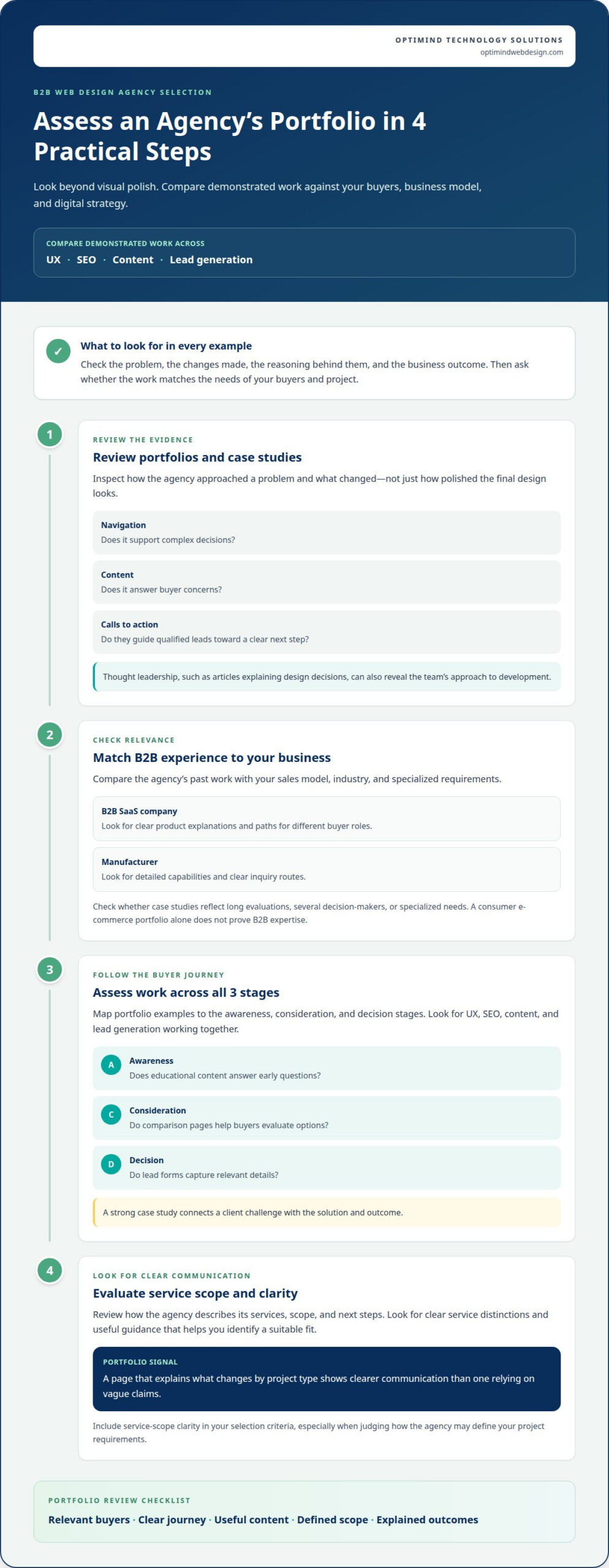
Philippine agencies differ in UX, SEO, content, and lead-generation expertise; compare demonstrated work across all four. Use practical criteria for selecting a B2B web design agency in the Philippines, assessing projects against your buyers, business model, and digital strategy.
-
Review Portfolios and Case Studies
Inspect portfolio projects and case studies for the problem, changes, rationale, and business outcome. Look beyond visual polish: check whether navigation supports complex decisions, content answers buyer concerns, and calls to action guide qualified leads. For example, a B2B service page should explain its value and make the next step clear. Thought leadership, such as articles explaining design decisions, can also reveal the team’s approach to development.
-
Check B2B Experience and Business Fit
Match the agency’s past work to your sales model and industry. A B2B SaaS company needs clear product explanations and paths for different buyer roles; a manufacturer may need detailed capabilities and inquiry routes. Check whether case studies reflect long evaluations, several decision-makers, or specialized requirements. Don’t treat a consumer e-commerce portfolio as proof of B2B expertise without relevant examples.
-
Assess Expertise Across the Buyer Journey
Map portfolio examples to the awareness, consideration, and decision stages. Check whether educational content answers early questions, comparison pages support evaluation, and lead forms capture relevant details. For example, see whether a case study connects a client challenge with the solution and outcome. This reveals whether UX, SEO, content, and lead generation work together or are treated as disconnected tasks.
-
Evaluate Service Scope and Clarity
Review how an agency presents its services, scope, and next steps. Look for clear descriptions, useful distinctions between service options, and guidance that helps you identify a suitable fit. A page that explains what changes by project type demonstrates stronger communication than one relying on vague claims. Include service-scope clarity in your criteria for choosing a B2B web design agency in the Philippines, especially when assessing how the agency may define your project requirements.
Is there even a single best B2B web design agency?
No single partner fits every Philippine business; compare local and international agencies by project fit, communication, and delivery approach. Before hiring, ask how the team will meet your goals, structure the site, test accessibility, and transfer ownership.
-
Define Goals, Timeline, and Requirements
Start by defining your business goal, such as generating qualified leads or presenting enterprise product information more clearly. Then specify the timeline, required features, and decision-makers. Separate essential functions from later enhancements, since a booking system or CRM connection may affect the project plan. Avoid a brief that counts pages but leaves success measures, responsibilities, and delivery milestones undefined.
-
Compare Agency Options and Ask Hiring Questions
Compare Philippine and international agencies on relevant experience, communication overlap, and how they handle local audience needs. Location alone doesn’t establish fit. Ask who will lead the work, how often progress updates arrive, and how feedback changes the schedule. Request a sample project plan, and ask how the team handles delays, revisions, and decisions that affect scope.
-
Assess Architecture, Accessibility, and Regional Needs
Evaluate the proposed architecture by user journeys, not page count. For example, a corporate site may need separate paths for procurement teams, technical evaluators, and prospective partners. Include web accessibility and mobile usability in the requirements. For Philippine audiences, assess whether content, contact options, and navigation serve the regions and customer groups your business targets.
-
Choose Between Optimization and Redesign
Improve the existing site when its core message works but specific pages hinder conversion. Choose a redesign when positioning or technology blocks the required experience. In either case, agree on analytics, lead-generation goals, and ownership of the website files and domain after completion. For a clearer starting point, outline your goals in a project-fit discussion.
Client testimonials and agency background checks
For a Philippine agency, validate claims through references, project examples, and direct discussion with the people assigned to your work. Ask former clients about delivery, adaptability, and feedback; compare their accounts with the portfolio and stated project roles. Document answers for consistent comparisons.
-
Verify Client Outcomes Through References
Ask the agency to connect you with a reference whose project resembles your audience, scope, or sales process. Find out what goal was agreed, what changed during delivery, and whether the final work supported that goal. If a case study reports stronger lead quality, for example, ask how the client defined qualified leads and what evidence they used. Distinguish measured outcomes from impressions.
-
Check Reviews and Testimonials
Look for specific details in testimonials about communication, handoffs, problem solving, and follow-through, not just praise. Compare recurring themes across review platforms and case studies. A comment about timely feedback is more useful when it refers to a specific project moment. Check whether the reviewer is identifiable as a client representative and whether the project type matches your needs. Treat anonymous claims as context, not proof.
-
Assess Team Capabilities and Track Record
Meet the people responsible for strategy, design, development, and quality checks. Ask each person to explain their role and describe a project challenge they handled. Their answers show whether the portfolio reflects the team you will work with, rather than only senior leadership. Discuss how they gather audience feedback, manage changes, and resolve conflicting input. A specific example of adapting page flow after client review demonstrates how collaboration works in practice.
Comparing payment terms and cancellation policies
A Philippine web design agreement should define the scope, deliverables, timeline, payment milestones, and cancellation process. Compare the written terms, not just the visual proposal.
-
Compare Project Scope and Deliverables
Check whether research, design, technical development, revisions, testing, and launch are included or treated separately. A proposal for a B2B website should name its deliverables, dependencies, and exclusions. This makes comparisons fair and reduces misunderstandings about what your team will receive.
-
Assess How the Work Supports Business Outcomes
Check how each proposal connects its scope to business outcomes. Ask which work supports lead generation, improves a conversion path, or addresses a technical constraint. Do not judge value by visual polish alone: a clear strategy may better support your sales process. For ROI planning, agree on relevant measures, such as qualified inquiries, and how results will be tracked after launch.
-
Review Payment Terms and Milestones
Tie each payment milestone to a named project stage and approval event. For example, the agreement can specify when discovery, design approval, development, testing, and launch are accepted. Confirm the invoice schedule, payment method, review period, and process for approving changes. Clear checkpoints help your team track progress and link payment obligations to completed work.
-
Check Deliverables and Cancellation Policies
Confirm the agreement identifies final files, access credentials, documentation, and responsibility for transferring website assets. Read how either party can end the engagement, what notice is required, and how completed work is handled. Clarify which unfinished deliverables transfer and how outstanding obligations are settled. To align your project scope and delivery plan, discuss your B2B website requirements.
Optimind Technology Solutions
Optimind Technology Solutions helps Philippine businesses turn agency-selection priorities into a clear website direction. If you have compared portfolios and contract terms but still need a partner to shape the project, its web design and development work can align the site with your sales process, audience, and operational needs. The focus is not simply selecting a design; it is defining a practical digital foundation for your business.
Bring your goals, required functions, current website challenges, and agreed project scope to the discussion. These details help shape a plan around what your team needs the website to do. For example, a company that needs to simplify complex user journeys may benefit from UX design, while specialized business workflows may call for custom web application development. The right direction depends on your requirements.
Optimind also provides e-commerce development for businesses that need online shopping functionality as part of their digital presence. Clear project requirements connect design decisions to buyer tasks, internal processes, and the next action you want visitors to take. This gives you a stronger basis for evaluating how the proposed work fits your business, rather than judging a site by appearance alone.
Use these selection criteria to guide a focused conversation: explain your audience, clarify essential features, and identify the terms that matter to your team. Optimind Technology Solutions can discuss how its services relate to your project scope and business goals. You can then assess the fit against the outcomes and working terms you have defined.
Contact Optimind Technology Solutions to discuss your B2B website project.
Turn Your Agency Decision Into a Clear Project Brief
Your next step is to turn your B2B web design agency selection criteria for the Philippines into a focused project brief. Define the business problem, the audience your website must serve, and the decisions visitors should be able to make. This gives your chosen partner a practical foundation for shaping the work around your priorities.
Optimind Technology Solutions supports this next stage with Web Design and Development, Custom Web Application Development, and UX Design. Its team can translate your requirements into a digital experience shaped around your business workflows, buyer needs, and planned functionality. A clear starting brief makes it easier to discuss the right approach and align the project with your goals.
Bring your priorities and project requirements into the conversation, then decide on a direction that fits your organization. Contact Optimind Technology Solutions to discuss your B2B website project and take the next step with clarity and confidence.
Frequently Asked Questions
When Shouldn’t You Acquire Web Design and Development in the Philippines?
A new build may not be necessary if your current site supports your goals and your team can address the specific problem. If visitors struggle to find a service page, for example, first identify whether clearer content or navigation could solve the issue. A focused improvement may suit you better than a full redesign when your positioning and core site structure remain effective.
What criteria should businesses use to choose a B2B web design agency in the Philippines?
Choose an agency that can connect its approach to your business model and user needs. Look for examples of how it handles complex products, multiple decision-makers, or specialized workflows. Then assess who will do the work, how feedback is managed, and whether the deliverables support your internal team after launch. These details distinguish a practical partner from a polished presentation alone.
How can you evaluate a Philippine agency’s B2B web design portfolio and case studies?
Assess each case study by tracing the client challenge through the agency’s work to the result. Check whether it explains the agency’s specific contribution instead of presenting the finished site without context. For example, look for details about redesigned product navigation, clearer technical information, or an improved inquiry flow. A useful case study gives you enough information to judge whether its approach suits your audience.
What are the risks of hiring a low-cost or offshore web design agency, and how can you mitigate them?
Risks include unclear responsibilities, communication delays, and a gap between promised scope and delivered work. These issues can affect local and offshore projects alike. Reduce ambiguity with a written brief, named project contact, agreed update routine, defined revision process, and clear ownership terms. If teams work across time zones, set shared response windows and decision deadlines so approvals do not stall progress.