
A board approves business outcomes, not a feature list. To show how to justify a custom web development budget to the executive board, tie the project to a specific business goal, include implementation and staff training in the full budget, and estimate the annual value of additional customers. Present the case as an investment with measurable assumptions, not a technology wish list.
You may already know your website needs to do more than the current system allows. The challenge is showing why the work matters to the business and how you will assess its results. This guide offers a practical framework for making that case clearly and credibly.
Connect business objectives to project scope, account for the work required beyond development, and calculate customer value using your own data. The result is a board-ready proposal that explains what the project enables, what it requires, and how you will measure its contribution.
Key Takeaways
- Connect the proposed website or application to a specific business objective, then define how progress will be measured.
- Map the full project scope, including implementation, staff training, testing, and ongoing support, before presenting the budget.
- Use annual customer value and realistic acquisition assumptions to show how improved website performance could contribute to revenue.
- Frame the board proposal around business impact, clear assumptions, and a focused first release rather than a feature list.
Aligning budget allocations with project objectives
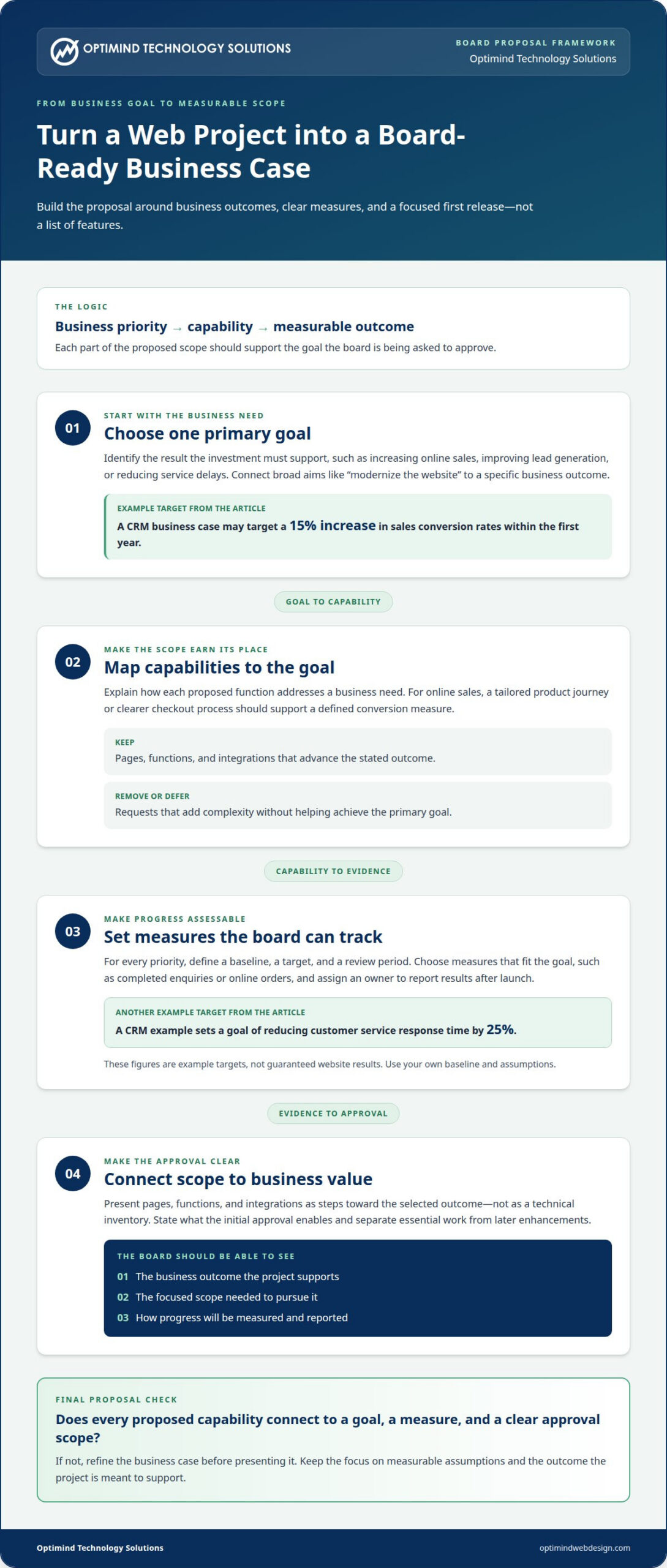
Build the proposal around business priorities, then link each planned capability to a measurable outcome. This keeps the board’s decision focused on value, scope, and evidence.
-
Define the Business Goals
Identify the business goals the investment must support, such as increasing online sales, improving lead generation, or reducing service delays. Choose a primary outcome and define how to measure it. For example, a CRM business case may target a 15% increase in sales conversion rates within the first year. Avoid goals like “modernize the website” unless you connect them to a business result.
-
Map Technology Investments to Goals
Map each proposed capability to the goal it supports. When justifying a custom web development budget to the executive board, explain how each feature addresses a business need. For an online sales objective, for example, a tailored product journey or clearer checkout process should support a defined conversion measure. Remove requests that add complexity without advancing the stated objective.
-
Set Measures the Board Can Track
Choose a baseline, target, and review period for each priority. A CRM example sets a goal of reducing customer service response time by 25%; for a website, select measures tied to your goal, such as completed enquiries or online orders. Assign an owner to report results after launch, so board members can assess progress against the same measures used in the proposal.
-
Connect Scope to Business Value
Present proposed pages, functions, and integrations as steps toward the selected outcome, not as a technical inventory. Explain what the initial approval will enable. Separate essential work from later enhancements so the project’s purpose, boundaries, and expected business contribution are clear.
Align IT goals and investments with business objectives, including website traffic or online sales. A case projects a potential $200,000 revenue increase from improved sales tracking and customer retention over two years. In participatory budgeting, the management board sets general directions and goals; managers create budgets based on those guidelines.
Avoiding hidden implementation and training costs
Plan for the work required to launch and manage the website, not just its development. Map the people, systems, and approvals involved before finalizing the scope.
Custom development can support specialized workflows, while templates or SaaS platforms may suit standard needs. Compare flexibility, implementation effort, and ongoing commitments against your requirements.
In the Philippines, involve finance, procurement, and privacy teams early. They can identify applicable tax treatment, purchasing procedures, and data privacy requirements for the project.
-
Separate One-Time and Recurring Work
Classify activities by timing and ownership. One-time work may include implementation, data migration, integration, and staff training. Ongoing work may include support, updates, and third-party services. Include internal staff time, too: teams can overlook preparation and testing when they budget only for external development.
-
Identify Requirements Affecting Project Scope
Ask finance, procurement, and privacy teams to identify applicable requirements before approving the project plan. For example, a website that collects customer details needs a defined approach to access, storage, and handling. Procurement procedures may shape approvals and documentation, while tax treatment affects financial records. Do not assume every organization follows the same internal process.
- Assign shared tasks to the departments that produce or use the work. Marketing may prepare content, while operations defines workflow needs and IT coordinates integrations. Document each team’s role so the implementation plan reflects the organization’s workload, not just the development team’s tasks.
- Link the project plan to expected business benefits using the measures already selected for approval. Consider how improved workflows, fewer manual tasks, or more completed enquiries could support revenue, and state the assumptions behind each estimate. For tailored requirements, custom web development planning can help translate workflows into defined implementation tasks.
Include training in the website project budget so the website can be managed smoothly, alongside regular updates and support. Managers from different company departments contribute their departments’ financial resource perspectives and needs to budget planning, helping the plan account for shared obligations rather than only technical work.
A web design project budget should typically include a contingency fund equal to 10-20% of the total budget.
Estimating customer value over a year
Measure results after launch against a 12-month baseline, using customer acquisition, completed enquiries, sales, and service performance. Track the same measures over time, then compare actual outcomes with the assumptions in your business case.
- Calculate annual value per customer. Use your records to estimate the revenue one customer generates during a year, accounting for repeat purchases and renewals. Where relevant, subtract variable costs to understand the contribution to the business. Keep the calculation tied to a clear period, such as the first 12 months after acquisition, so the board can see what the estimate includes.
- Set a customer acquisition baseline. Record how many customers your business currently gains each month and the channels that bring them in. For example, if your baseline is 5 new customers monthly, use that as the starting point rather than presenting a hoped-for increase as established performance. Note seasonal patterns or sales-cycle delays that could affect monthly comparisons.
- Model a specific change. Estimate the effect of one additional customer per month, then connect that change to annual customer value. Show the formula, period, and assumptions instead of presenting an unexplained revenue projection. Keep estimates distinct from confirmed results so decision-makers can see how sensitive the case is to customer volume and retention.
- Track results across the customer journey. After launch, compare website visits, qualified enquiries, completed purchases, and repeat orders with the baseline. Link each measure to a business outcome: completed enquiries can indicate lead generation, while repeat orders can show returning customer activity. Assign an owner to report progress regularly and note whether operational changes affect the results.
- Review performance over the year. Use consistent reporting periods and definitions throughout the first year, then compare actual customer value with the original estimate. If an early indicator, such as completed enquiries, changes before annual revenue does, report both measures and explain how they relate. This gives the board a clearer view of progress without treating early signals as final returns.
Justifying IT investments to executives or board members
Present a strategic decision, not a technical wish list. Show how the options, phases, and review points connect to business results.
Offer executives a complete project, a focused first phase, and a defer option. For each, explain the scope, dependencies, and expected outcomes. Stage implementation around usable releases, with approval gates based on evidence from each phase.
-
Build the IT Investment Case
Lead with the business problem, then show how the proposed investment addresses it. Give board members the expected outcome, key assumptions, and measures used to assess progress. A sample CRM business case projects a 300% return on investment over three years and reaches break-even within 1.5 years. Treat those figures as an example, not a forecast for your website.
-
Plan Phased Implementation
Divide delivery into stages, each with a defined outcome and decision gate. Start with essential functions, then schedule later features after reviewing usage, operations, and initial performance. This lets executives approve a clear first release while seeing how future phases depend on demonstrated needs, rather than committing to the full scope without review.
- Compare options side by side using consistent criteria: scope, business outcome, dependencies, and delivery sequence. For example, a focused release could support core customer enquiries first, with workflow automation added later. State what each option includes and excludes; otherwise, board members cannot weigh the trade-offs or see what their approval enables.
- Set governance before work begins. Name the executive sponsor and decision owners, establish a reporting cadence, and define what evidence will trigger a scope or phase review. Keep assumptions visible, including customer uptake and internal readiness. A strategic proposal should explain what happens if early measures fall short, rather than presenting projections as guaranteed results.
- Close with the decision required: approve the first phase, approve a staged plan, or defer pending a defined business condition. Summarize the expected outcome, dependencies, and review gate in a concise board brief. To turn operational requirements into a phased digital plan, discuss custom web application development.
Optimind Technology Solutions: Custom Web Application Development
Optimind Technology Solutions helps you turn approved digital plans into custom web applications built around your business workflows. Turn to the team when standard website functions cannot support the processes, integrations, or user journeys your project requires.
For customer-facing websites, Web Design and Development and UX Design can align the user experience with your business goals. E-Commerce Development supports online shopping journeys and transaction functionality. Each project is grounded in your requirements and approved outcomes, keeping the work tied to the case presented to the board.
Bring your goals, priorities, and proposed scope to Optimind Technology Solutions. Contact the team to discuss your web application project.
Turn board approval into a clear delivery mandate
Once your board has approved the direction, turn that decision into a practical starting point: identify the internal lead, confirm who can make day-to-day decisions, and set a clear process for resolving roadblocks. A capable web development team can help translate the approved brief into a delivery plan that keeps business priorities in view.
Knowing how to justify a custom web development budget to your executive board is only part of the work. Carrying the approved plan forward is the next step. Keep the project sponsor engaged as the team moves from planning to delivery, and make every decision serve the mandate the board approved.
Ready to discuss your project’s next step? Contact the team and move your digital plan forward with confidence.
Frequently asked questions
How much technical detail should a board proposal include?
Explain technical choices in terms of business impact. Include details only when they affect delivery risk, system integration, security, or the organization’s ability to support the project. Keep specialist terminology brief and define it when needed.
Who should present the proposal to the board?
The project sponsor should lead, with finance and technology representatives ready to explain the business case and delivery approach. This gives board members a clear owner for the request and direct answers about its financial and technical implications.
What should you do if the board asks for revisions?
Record each concern and identify what evidence or clarification would address it. Revise the proposal before resubmitting, keeping the business objective consistent while adjusting the explanation or scope to respond directly to the board’s feedback.