Choose an individual WordPress developer when your website needs focused technical work and the requirements are clear. Choose a web agency when delivery calls for several skills and coordinated project ownership. The right fit depends on the work your business needs, the people available to guide it, and the level of ongoing development your website requires.
The WordPress developer vs web agency decision affects more than who writes the code. It shapes how you coordinate design, communicate changes, manage responsibilities, and plan custom functionality. Compare those differences against your business priorities rather than assuming one model is always better.
This article explains how to assess project scope, flexibility, specialist support, and custom development before you choose. You’ll gain a practical framework for matching the working relationship to your website’s requirements, so you can set clearer expectations, make more informed decisions, and move into development with a shared understanding of what the project needs to accomplish.
Key Takeaways
- Match the hiring model to your workload: a defined task may suit an independent developer, while ongoing or complex work can call for a coordinated team.
- Set expectations for communication, availability, and continued support before work begins so responsibilities stay clear after launch.
- Consider custom development when your website needs specific features, integrations, or workflows that a standard setup cannot meet.
- Choose a partner based on project scope, technical requirements, and who will manage design and development, not team size alone.
In-House Developer vs WordPress Agency: Which Should You Hire?
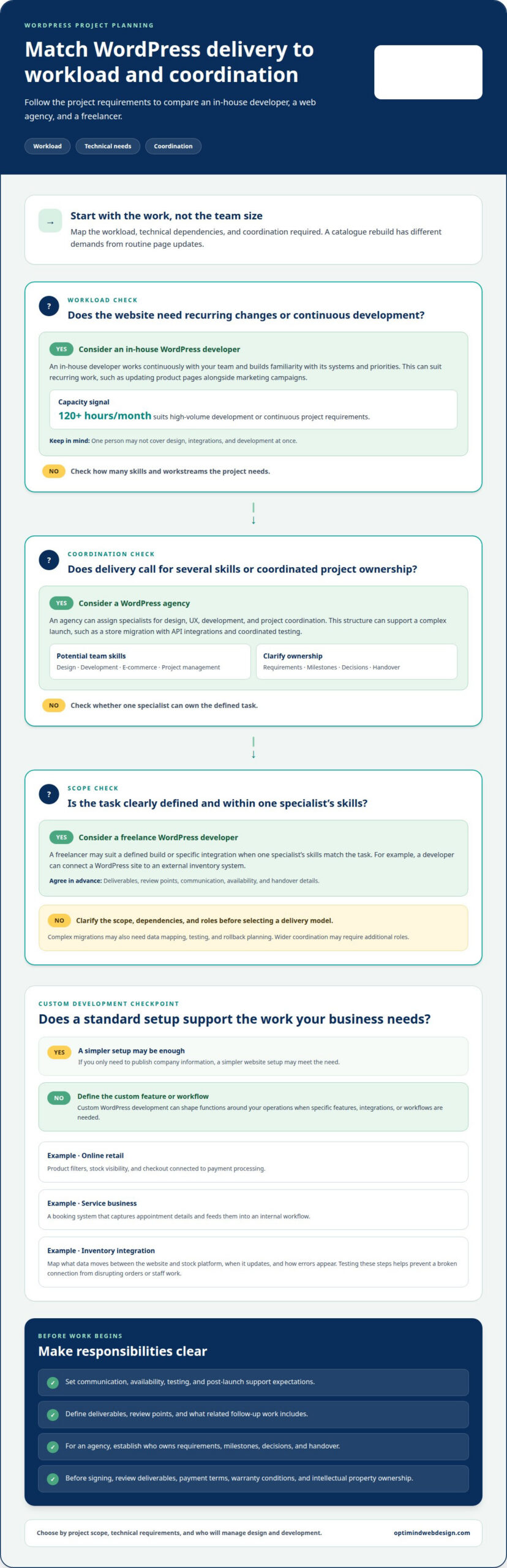
Choose by mapping the workload, technical dependencies, and coordination required. A catalogue rebuild, for example, has different demands from routine page updates.
In-House WordPress Developer
An in-house developer works continuously with your team, building familiarity with its systems and priorities. This suits recurring changes, such as updating product pages alongside marketing campaigns. One person may not cover design, integrations, and development at once. A capacity level of 120+ hours/month suits high-volume development or continuous project requirements.
WordPress Agency
An agency can assign specialists for design, UX, development, and project coordination. That structure can support a complex launch, such as a store migration with API integrations and coordinated testing. Philippine web agencies may include design, development, e-commerce, and project management. For end-to-end management, establish who owns requirements, milestones, decisions, and handover.
Freelance WordPress Developer
A freelancer may suit a defined build or specific integration when one specialist’s skills match the task. For example, a developer can focus on connecting a WordPress site to an external inventory system. Complex migrations also need data mapping, testing, and rollback planning. Choose this model when responsibilities are narrow; wider coordination may require additional roles.
| Option | Scope | Continuity | Management |
|---|---|---|---|
| In-house | Recurring work | Ongoing | Internal coordination |
| Agency | Multi-skill projects | Team-based | May manage end to end |
| Freelancer | Defined tasks | Agreed engagement | Client-led or agreed |
Choose a freelancer for a focused task; choose an agency for coordinated, complex delivery. Evaluate Philippine providers through relevant portfolio examples, references, proposed scope, and milestones. Before signing, review deliverables, payment terms, warranty conditions, and intellectual property ownership.
Freelancer flexibility and scope
A freelancer can suit a focused WordPress task, such as refining an event registration flow or adjusting how staff publish updates. This direct arrangement works well when the requirements are clear and one specialist can complete the work. Agree on deliverables, review points, and handover details before development starts.
For one-off work, define where the requested change ends and related follow-up begins. If a new registration form also needs confirmation emails, specify whether both are included. Clear boundaries help you plan decisions and avoid leaving connected website functions unfinished.
Communication is usually direct between you and the developer. Set a preferred channel, feedback schedule, and process for urgent questions. For example, agree to review a staging page before launch. This creates a shared rhythm, even when your internal team works on different schedules.
A dedicated developer works with your business for an agreed period or capacity, while a freelancer may serve several clients and projects. A dedicated arrangement can support regular collaboration with your marketing or operations staff. A freelancer can offer flexibility for discrete needs, with availability shaped by the engagement and agreed schedule.
Choose a setup that matches the support your team can provide. If you can supply website design, content, and timely decisions, a freelancer may handle a contained build efficiently. If your staff needs frequent coordination across multiple workstreams, plan for dedicated support or project management. Set expectations for communication, testing, and post-launch assistance before work begins.
Custom WordPress development
Custom WordPress development suits businesses that need more than a standard page layout. A pre-made theme can support familiar content pages, while a tailored build can shape functions around your operations. For example, a training company may need course listings, enrolment forms, and different access for learners and administrators. The WordPress developer vs web agency decision should reflect who can deliver those requirements.
Start with the business task, then define the user journey and required features. An online retailer might need product filters, stock visibility, and checkout connected to payment processing. A service business could need a booking system that captures appointment details and feeds them into an internal workflow. These examples translate technical choices into operational requirements.
Custom work can also connect WordPress with other systems. An inventory integration, for instance, can keep product information aligned between a website and a separate stock platform. The developer must map which data moves, when it updates, and how errors appear. Testing these steps helps prevent a broken connection from disrupting orders or staff work.
Choose a delivery model by identifying the skills and decisions the build requires. One specialist may suit a contained feature with clear requirements. A project combining UX, design, development, and several integrations may benefit from coordinated roles and end-to-end management. For the WordPress developer vs web agency decision, define acceptance criteria, test scenarios, and handover responsibilities before implementation begins.
Custom development is worthwhile when a specific workflow creates value that a standard setup cannot support. It is not automatically right for every website. If you only need to publish company information, a simpler setup may be enough. If unique functions affect sales, service delivery, or daily operations, assess the build against those business outcomes.
What does a freelance WordPress developer do compared with a web design agency?
A freelance WordPress developer works within WordPress, turning design plans into functional pages and features. For a corporate site, that could mean building a staff directory, refining a contact form, or making navigation work across mobile screens. You usually coordinate the developer’s work with your own marketing or design team.
A web design agency can bring together design, user experience, development, and project coordination. For example, a business launching a new service page may need audience research, page layouts, WordPress implementation, and testing. Agency specialists can manage these connected tasks through one project plan, rather than leaving you to coordinate each role separately.
A developer’s focus is often technical execution. They can code a designer’s plans, connect a plugin, or fix a display issue in a specific page template. If your internal designer has prepared layouts, this division can keep responsibilities clear. You provide requirements and feedback; the developer builds and tests the agreed features.
An agency may also shape the visual system and user journey before development starts. For example, a membership organisation may need a refreshed identity, clearer navigation, and an online application flow. Design and development can then work together, reducing gaps between approved layouts and the finished WordPress experience.
Decide who owns each project stage: planning, design, coding, testing, and launch. A freelancer can suit a defined development task when design direction is already in place. An agency can suit a project that needs several skills and coordinated delivery. In either model, name one decision-maker and document what completion means.
How to choose a WordPress development partner
Start with the business outcome, then define the work needed to achieve it. For an online store, that may mean improving product discovery, connecting payment processing, or streamlining checkout. A brochure site may instead need clear page templates and a simple enquiry path. The WordPress developer vs web agency decision should reflect the functions your business needs, not assumptions about team size.
Next, map responsibility across planning, design, development, testing, and handover. If your team already has approved designs, a developer can focus on implementation. If the project needs UX decisions, visual design, integrations, and delivery coordination, an agency can bring those roles together. Name one person on your side to approve requirements and feedback.
- Review relevant work: Compare examples with your project, such as an e-commerce build or custom booking system.
- Test technical fit: Match proposed skills to your needs, including migrations, API integrations, or WordPress customization.
- Define delivery: Record milestones, review points, testing expectations, and the handover materials your team needs.
- Set communication: Agree on the main contact, update schedule, decision process, and how changes affect scope.
Use a practical decision rule: choose a freelancer for a contained task with clear requirements and an internal owner. Choose an agency when several disciplines must work together or your business needs end-to-end project management. For ongoing work, assess the workload and continuity your team requires.
Before work begins, document deliverables, payment terms, support boundaries, and ownership of the finished work. For example, specify whether handover includes administrator access, project files, and site management instructions. A useful WordPress developer vs web agency comparison ties responsibilities to project needs and gives your team a clear path from approval to launch.
The WordPress developer vs web agency decision should support how your business plans to operate, not just the immediate build. Before development begins, align the website’s purpose with the workflows, customer experience, and internal responsibilities it must serve. That gives the project direction and keeps technical decisions connected to business needs.
For projects that need coordinated design and development, Optimind provides web design and development, custom web application development, and UX design. These disciplines come together to shape websites and applications around practical business requirements.
Take the next step with a clear view of your priorities, required features, and preferred working relationship. Contact Optimind Technology Solutions to discuss your WordPress project and define a focused path forward. With the right scope and expertise in place, your website can become a stronger platform for serving customers and supporting growth.
Frequently Asked Questions
What should you consider before choosing?
Define the business outcome, decision-makers, and systems the website must support. For example, a corporate site connected to a customer database has different requirements from a simple information site. Decide who will supply content, approve design decisions, and maintain the site after launch. These details reveal the coordination your project needs and help prevent overlooked dependencies from disrupting delivery.
When does an agency make sense?
An agency makes sense when several disciplines need to work in sequence or in parallel. A business expanding its website across departments, for example, may need shared design standards, content planning, development, and stakeholder reviews. A coordinated team can manage these workstreams under one delivery plan, reducing the burden on your internal staff to align separate specialists.
How long does it take a WordPress developer versus an agency to build a website?
There is no single timeline for every project. Delivery depends on scope, approvals, content readiness, and technical requirements. A site with prepared copy and established layouts follows a different path from a rebuild involving data migration or third-party connections. Agency coordination does not automatically speed up development, and one developer’s schedule does not determine the full project duration.
What are the pros and cons of hiring a freelance WordPress developer versus a web agency?
A freelancer offers direct communication with the person doing the development, which can simplify decisions on a contained assignment. The trade-off is that one person has limited capacity across different disciplines. An agency can coordinate design, UX, and development, but its process may involve more stakeholders. The best fit depends on whether you value direct specialist collaboration or coordinated delivery.